
TLDR
The best Grifball maps make the match understandable at a glance. Players should immediately recognize the center-ball spawn, both goals, court boundaries, teammate positions, and the safest route back into play. Winter League 2008 is the obvious historical starting point because Halo describes it as a recreation of the original Foundry court, but that does not automatically make it the best competitive Halo Infinite map. For serious customs, favor clear geometry, safe and direct spawns, strong goal contrast, clean collision, and lighting that keeps every Spartan readable.
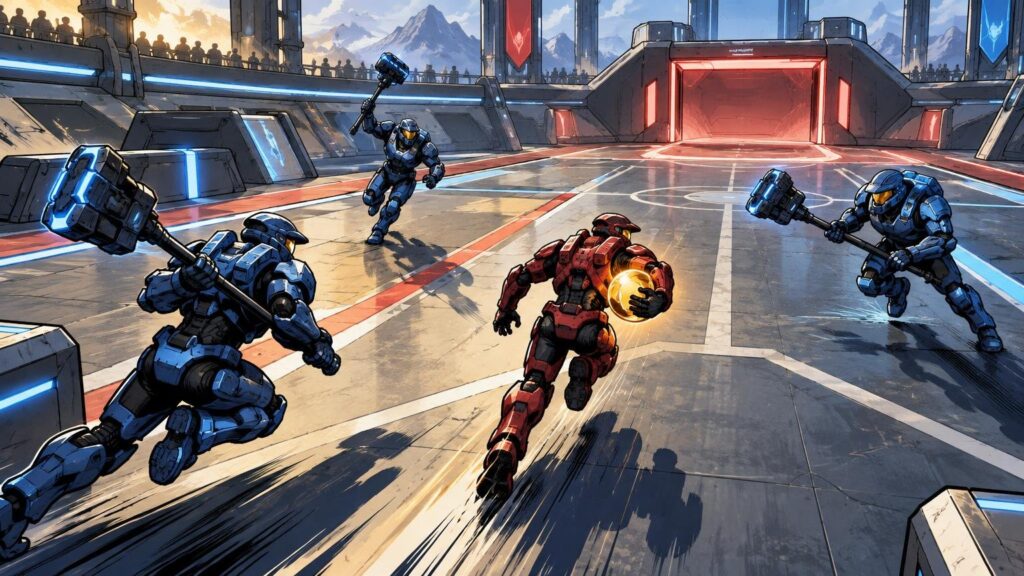
Grifball is controlled chaos: eight players, two weapon types, one ball, and roughly four thousand hammer swings in the space where a sensible game might place a tasteful lobby. That apparent simplicity makes court design unusually important. A tiny visibility problem or awkward floor seam can affect the entire match.
The search for the best Grifball maps should therefore begin with playability, not scenery. A spectacular theme is a bonus. The court still needs to communicate where to run, where danger is coming from, and whether the Runner has crossed into scoring range before the next hammer blast rearranges the room.
The best Grifball maps start with competitive readability
Halo Infinite’s launch lineup for the modern mode included Classic, 3P Classic, Octane, and 3P Octane. The official rules summary describes 4v4 matches built around Gravity Hammers, Energy Swords, and a ball carrier known as the Runner, who receives an Overshield and altered movement. Matches can last up to five three-minute rounds, with victory at three scores. If the rules are unfamiliar, our introduction to Grifball’s rules and appeal covers the basic sport before diving into map analysis.
Those rules concentrate attention in predictable places: the center opening, the route between center and goal, each defensive line, and the spawn exits. A good court makes all four spaces legible even when explosions, outlines, weapon effects, and several overlapping players fill the screen.
Readability does not mean a map must look plain. It means decoration supports play rather than competing with it. Strong landmarks can help players orient themselves after a spawn. Contrasting floor treatments can identify the scoring ends. Lighting can separate character silhouettes from the background. The trouble starts when bright props resemble objectives, deep shadows hide defenders, or decorative edges look like playable routes.
A practical Grifball court scorecard
Use the following checks when choosing a court for custom games or evaluating a Forge creation. They are more useful than asking which map has the coolest skybox.
| Design factor | What strong courts do | Warning signs |
|---|---|---|
| Center-ball readability | Make the opening objective and approach lanes obvious from both ends | The ball blends into effects, floor markings, or decorative clutter |
| Spawn flow | Return players safely and point them naturally toward the match | Players spawn disoriented, exposed, or facing away from the action |
| Goal clarity | Use shape, color, lighting, or landmarks to identify both scoring ends | The goal plate disappears beneath combat effects or resembles ordinary flooring |
| Boundaries | Show the playable limits without requiring trial and error | Decorative gaps and ledges appear traversable but are not |
| Collision | Keep the main movement surface smooth and predictable | Seams, props, ramps, or invisible edges interrupt strafing and lunges |
| Sightlines | Allow players to read teammates, threats, and open routes | Large props or lighting effects conceal important movement |
| Orientation | Give each end a distinct identity without creating an unfair visual advantage | Both ends look interchangeable after a hectic respawn |
Halo Support’s Community Forge Map Requirements reinforce several of these principles. Its guidance calls for safe respawns that naturally direct players toward the action, clear boundaries, smooth traversable collision, intentional skill movement, and lighting that preserves legibility. Halo’s Community Forge Map Requirements Although those requirements apply broadly to community maps, they fit Grifball especially well because nearly every relevant interaction happens at close range.
Which official Halo Infinite courts should you try first?
Halo’s official Grifball collection listed ten arenas: Aquario, Coliseum, Gridiron, High Charity Court, Neon Night, Nexus, Way Up There, Scarry, Sigma Stadium, and Winter League 2008. These maps offer a broad visual range, but the official descriptions do not establish a competitive order. The most responsible shortlist depends on what your group wants to evaluate.
Winter League 2008: the classic reference point
Start with Winter League 2008 if your goal is to compare Halo Infinite with Grifball’s Foundry-era identity. Halo describes this court as a recreation of the original Foundry Grifball court. That makes it the clearest legacy reference in the official collection and an excellent first stop for returning players.
Treat it as a baseline rather than an automatic champion. Halo Infinite’s Grifball arrived with game-specific tuning, including a shorter Gravity Hammer swing cooldown, modified hammer physics, and the Duelist Energy Sword. Familiar proportions can feel different when weapon timing, knockback, movement, or camera perspective changes.
Gridiron and Coliseum: immediately readable themes
Halo identifies Gridiron as football-themed and Coliseum as grand-scale. Those identities make them sensible candidates for groups that want the arena-sport fantasy to be obvious. The key question is not whether the theme fits; it plainly does. The useful test is whether floor markings, backgrounds, and lighting keep the ball, goals, and player silhouettes distinct during an actual center scrum.
Neon Night and Nexus: a test for visual contrast
Neon Night uses a rainy nighttime New Mombasa and ODST-inspired presentation, while Nexus draws on a Miami Vice aesthetic. These are natural picks for players who value atmosphere, but they also demonstrate why screenshots cannot settle a competitive ranking. Bright signage and dramatic lighting can strengthen orientation when used around goals and boundaries, yet similar effects can become noise when they sit behind combat.
Run several rounds from both ends. Watch whether Energy Sword silhouettes remain visible against the background, whether the ball marker separates from signage, and whether one side is harder to defend because of glare or dark scenery. If players repeatedly call out visual confusion rather than tactical mistakes, the presentation is affecting the match.
Aquario, High Charity Court, Way Up There, Scarry, and Sigma Stadium
The remaining official themes span an underwater setting, High Charity, a court in the sky, Banished styling, and an outdoor stadium. That variety is valuable because each visual language creates different readability challenges. Organic Covenant forms may make boundaries less obvious than rigid arena markings. Outdoor backgrounds can reduce silhouette contrast. Elevated scenery can suggest routes that are outside the court.
None of those possibilities proves that a named court plays poorly. They are testing prompts. The best choice is the court that preserves its identity while passing the same geometry, contrast, spawn, and collision checks as every other contender.
How to test a map instead of guessing
A useful court test requires more than one quick match. Team skill, connection quality, unfamiliar rules, and a particularly enthusiastic hammer wielder can all distort an initial impression. Use a repeatable process instead.
- Confirm that everyone is using the intended map and matching mode version. Similar names do not guarantee matching scripts or settings.
- Play from both ends of the court. Record whether either background, goal area, or spawn direction is harder to read.
- Run the same court with Classic and Octane only if compatible versions are available. Do not assume movement changes leave spacing unchanged.
- Watch the opening contest. The ball, approaching players, and retreat routes should remain identifiable when both teams collide.
- Check every spawn. Players should return safely, face a useful direction, and understand how to rejoin the action.
- Strafe and lunge around the goal edges and main lanes. Note snags, unexpected elevation changes, or collision that interrupts deliberate movement.
- Ask players to describe the problem behind each conceded score. Repeated reports of unclear goals, hidden defenders, or disorienting spawns point to a map issue.
- Repeat the test with mixed-skill teams. A court should not require veteran map knowledge merely to understand its boundaries.
Older multiplayer design guidance associated with Bungie also emphasizes simplicity, orientation, navigation, circulation, sightlines, and iterative playtesting. Read the Bungie multiplayer map-design paper It is conceptual background rather than current Halo Infinite performance data, but its central lesson holds up: navigation must work under the pressure created by the game.
Classic and Octane may favor different spacing
A map recommendation should always name the tested variant. Halo introduced both first-person and third-person versions of Classic and Octane, while its launch notes also documented changes to hammer behavior and sword selection. Camera perspective alone can change how much nearby information a player receives, and movement tools can alter the time defenders have to recover.
That means a court can feel orderly in Classic but become harder to read when players change direction or close distance differently in another ruleset. It can also work the other way: extra mobility may make an otherwise slow recovery route more practical. These effects should be demonstrated through play rather than inferred from the theme or map thumbnail.
Teams trying the mode for the first time should begin with one court and one ruleset, then learn basic spacing through our guide to playing Halo Infinite Grifball without getting flattened. Changing the court, camera, and movement system simultaneously makes it difficult to identify why a match feels good or bad.
Cazaly belongs in a separate category
Cazaly should not be placed directly above or below standard box-court Grifball maps. Halo presented it as an AGLA-partnered Aussie Rules Grifball experience with passing, hand-offs, Thruster tackles, and an oval field. Those features change the spatial problem. Width, passing lanes, tackle approaches, and oval-field orientation matter more than maintaining the compact geometry expected from a traditional court.
Try Cazaly if your group wants an experimental team sport built from Grifball’s ingredients. Do not use its strengths or weaknesses as evidence that an ordinary Classic court will perform the same way.
What Forgers should prioritize
For a new court, begin with the competitive surface and objective language before constructing the surrounding spectacle. Halo’s Content Browser describes Grifball Court Canvas V 006 as a scripting canvas that uses required user labels and is intended for AGLA Grifball or AGLA Grifball: Thruster modes. View the official Grifball Court Canvas listing Verify the current version and paired mode before building or hosting because community files can be revised.
- Build a flat, predictable primary surface before adding decorative geometry.
- Make the center and both goals recognizable without relying only on small labels.
- Use landmarks to distinguish ends while keeping competitive visibility comparable.
- Keep spawn exits clear and point returning players toward useful decisions.
- Test hammer knockback, sword lunges, slides, jumps, and Thruster movement near every boundary.
- Remove props that resemble cover or routes but cannot actually be used.
- Check the court under combat effects, not just in a quiet Forge preview.
- Playtest with people who did not help build the map; their confusion will reveal assumptions the creator no longer notices.
Halo Infinite offers a much broader creation and sharing environment than early Grifball builders had. For a look at the old-school problem solving behind the sport, see our feature on forging a Halo 3 Grifball map. The tools changed, but the final standard did not: the court must play cleanly before it earns extra decoration.
The final call
Winter League 2008 is the best first map for players seeking a recognizable Foundry-era baseline. Beyond that, the best Grifball maps are the ones that survive structured playtesting: clear center contests, safe and direct spawns, unmistakable goals, smooth collision, visible boundaries, and strong silhouette contrast.
Choose two or three official courts whose themes appeal to your group, confirm their current map and mode versions in Halo Infinite, and test them from both ends under the same rules. Let visual style break a tie only after the fundamentals work. In Grifball, a beautiful court may earn the first bookmark, but a readable court earns the rematch.