
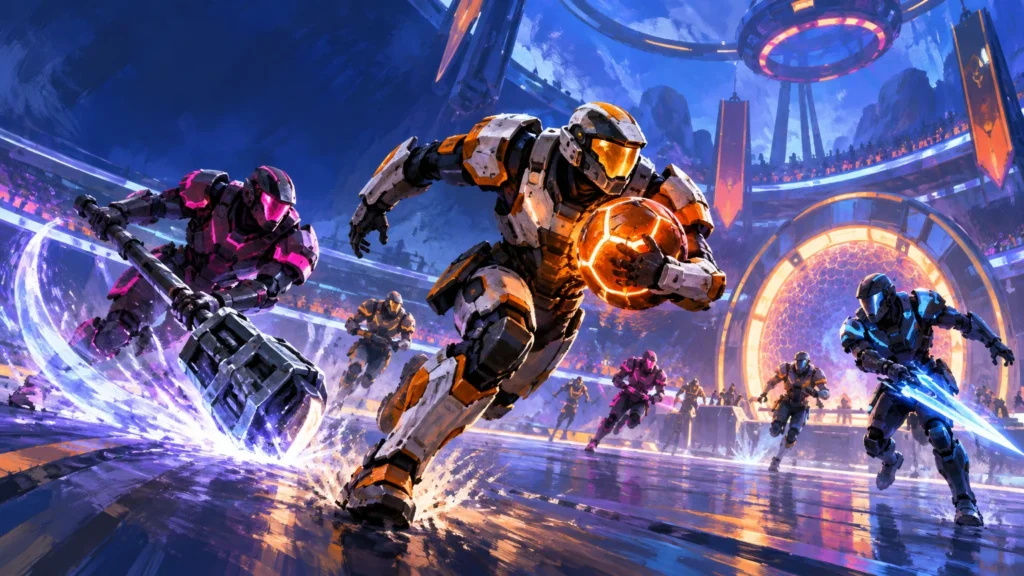
TLDR: Grifball is a community-born 4v4 Halo mode in which two teams fight over a ball in the center of an arena and try to carry it into the opposing goal. Players generally wield Gravity Hammers and Energy Swords, while the ball carrier is known as the Runner. It looks like close-range chaos, but good Grifball depends on spacing, attack timing, coordinated protection, and knowing when not to swing.
If you are wondering what is Grifball in Halo, the easiest description is “Halo turned into an arena sport.” There are no long-range rifle duels or vehicles rumbling over a battlefield. Instead, eight Spartans enter a compact court, contest one objective, and attempt to open a route through the other team. The official format is built around two teams of four and a centrally placed ball that must be carried to the opposing goal.
That simple premise explains only half its appeal. Grifball compresses Halo’s movement, melee combat, objective play, and team communication into short bursts of spectacular disorder. A new player can understand the objective almost immediately. Learning how to approach a hammer, protect a Runner, or survive a crowded midfield takes considerably longer.
What is Grifball in Halo, exactly?
A standard Grifball match begins with both teams separated from a ball at the center of the court. Players rush to establish control, one player picks up the objective, and that Runner tries to cross the arena and score at the enemy goal. The opposing team attempts to eliminate the Runner, recover the ball, and reverse the attack.
Most versions remove the broad weapon sandbox associated with regular Halo multiplayer. Grifball’s identity instead revolves around Gravity Hammers, Energy Swords, and the ball. Halo’s official history of the mode describes these weapons and the Runner as central parts of its modern form. That limited loadout makes every movement easy to read in theory: somebody is carrying, clearing space, protecting a lane, or preparing to stop the next push.
The exact settings are not universal. Movement speed, shields, friendly fire, score limits, equipment, round structure, and ball behavior can change between Halo releases or community variants. In the Halo Infinite version described by Halo, for example, the Runner gains an Overshield plus increased forward and lateral movement speed. Those bonuses make the carrier dangerous, but they do not replace teamwork. A Runner isolated in front of four defenders is still in a grim spot.
How a Grifball attack works
The flow of a match can be understood as a repeating four-step contest:
- Win or disrupt the opening fight around the central ball.
- Choose who will carry it and establish a safe pocket around that Runner.
- Clear or pull defenders away from a usable route to the goal.
- Score, or recover quickly if the opposing team stops the push.
The Runner is the player carrying the ball, but that does not automatically make the role a solo starring part. The carrier must judge whether to advance, pause behind teammates, change lanes, or retreat from an incoming swing. The three teammates without the ball have more freedom to engage defenders, threaten space, and intercept anyone approaching from the side.
There is no need for a beginner group to adopt rigid positions. A useful starting framework is one Runner, two players working ahead or beside the carrier, and one player watching for a defensive break or loose-ball reversal. Those jobs should change as the ball changes hands. The player nearest a dropped ball may become the new Runner, while the former carrier immediately shifts into protection.
This is where inexperienced teams often lose the plot. Four players can become so absorbed in swinging at the nearest opponent that nobody notices the exposed ball or the enemy Runner moving through an empty lane. In Grifball, an elimination matters because of the space or time it creates. Chasing one that has no connection to the objective can hand the other team a score.
Why Gravity Hammers and Energy Swords fit the mode
Grifball’s signature weapons force the action into close range. The Gravity Hammer creates disruptive, visually dramatic engagements, while the Energy Sword gives players another immediate melee threat. Their presence turns the court into a network of danger zones: move too early and an opponent can read the approach; wait too long and the Runner may pass the point where a challenge can stop the score.
The restricted arsenal also makes the mode approachable. Beginners do not have to memorize weapon pads, ammunition timers, sniper sightlines, or vehicle counters before contributing. They can focus on the ball, nearby threats, and the movement of their teammates. The deeper learning curve comes from making those apparently simple decisions under pressure.
What does “dancing” mean in Grifball?
Grifball players use “dancing” to describe the timing and positioning contest that happens before and during a melee engagement. Halo’s official explanation highlights baiting attacks, backsteps, sidesteps, and reading opponents as parts of this exchange. It is not simply two players sprinting forward and pressing the attack button at the same moment.
Picture an opponent guarding a narrow route to the goal. Charging directly gives that defender a straightforward read. A small hesitation might draw an early attack. A sidestep might change the angle. A teammate entering from another direction might force the defender to choose between two threats. The mechanical details vary by game and ruleset, but the decision remains recognizable: provoke a commitment, avoid its dangerous window, and respond when the route opens.
That is why indiscriminate swinging tends to produce inconsistent results. Each unnecessary attack temporarily commits the player to an action and may leave the Runner unprotected. Good teams create a rhythm in which one threat draws attention while another advances. The court may look like a blender from the spectator view, but the players inside it are constantly reading distance, movement, and intent.
Where Grifball came from
Grifball has unusually strong community roots even by Halo standards. Halo’s official account says the idea began as a joke in Rooster Teeth’s Red vs. Blue and was then brought to life with Halo 3’s Forge tools. Halo also identifies Forge as the birthplace of Grifball and other community-created experiences that endured beyond their original maps and games.
That origin matters because Grifball was not merely designed as another conventional shooter playlist. It emerged from the collision of machinima culture, a memorable joke, player experimentation, and Halo’s map-building tools. The community could build courts, adjust mode settings, organize matches, and refine how the sport should feel.
Halo 3 therefore remains the natural historical starting point for understanding the mode. Readers interested in the construction side can see how creators approached forging a Halo 3 Grifball map. The limitations of older Forge tools demanded ingenuity, while later toolsets made it easier to create more elaborate courts and scripting.
Grifball’s survival across multiple Halo eras also shows how firmly it became attached to the series. Xbox Wire announced its addition to Halo 5: Guardians through the Hammer Storm update on February 24, 2016. Later incarnations and community recreations changed details, but the recognizable core—two teams, one ball, opposing goals, and melee-heavy combat—remained.
Why Grifball became a Halo fan favorite
The first reason is clarity. Even someone watching for the first time can identify the ball carrier and understand where that player is trying to go. Grifball has the readable objective of a sport without abandoning Halo’s shields, movement, weapons, and explosive presentation.
The second reason is social flexibility. A casual group can enjoy the immediate comedy of hammers, sudden reversals, and crowded goal-line stands. Competitive players can concentrate on coordinated pushes, spacing, baiting, and controlled engagements. The same rules support both noisy party play and serious team strategy without requiring the objective itself to become more complicated.
Third, Grifball produces stories quickly. A desperate interception can turn defense into a scoring chance within seconds. One well-timed challenge can clear a route. A team that appears trapped near its own goal can recover the ball and send everyone racing in the opposite direction. Those reversals make matches memorable even when nobody is tracking individual statistics.
Finally, it belongs to Halo’s creative culture. Forge allowed a community joke to become a playable mode, and players continued building courts and organizing competition around it. Historical league coverage, including the site’s European Grifball League postseason review, offers a snapshot of how organized play grew around that foundation. It should not be treated as a current event calendar, but it demonstrates the mode’s life beyond matchmaking.
Can you play Grifball in Halo Infinite?
Grifball has appeared in Halo Infinite matchmaking, but availability should be treated as changeable rather than permanent. Halo Infinite’s Summer Update 2025 patch notes said Grifball rotated into matchmaking alongside the Halo 3-focused Delta Arena variant. The supplied Halo Support playlist reference also lists Grifball: Classic and Grifball: Octane within the 4v4 Arena Social Match Composer.
Because playlists and Match Composer selections can rotate, check the current in-game menus and Halo Support multiplayer playlist listing before assuming either variant is active. “Classic” and “Octane” are distinct named selections in the official listing, but players should consult their current descriptions for exact settings rather than assuming every rule is shared.
If matchmaking does not offer what you want, Halo Infinite’s Forge and Custom Games ecosystem can provide another route, depending on the maps and modes currently shared by creators. The practical process is covered in our guide to playing Halo Infinite Grifball without getting flattened. Players comparing different releases can also consult our guide to the best Halo games for Grifball fans.
Five useful tips for a first match
- Track the ball before chasing an opponent. If you cannot say where the Runner is, reassess the play.
- Do not crowd teammates unnecessarily. Several players stacked together can be disrupted at once, leaving the objective exposed.
- Treat every attack as a commitment. Watch distance and timing instead of swinging continuously.
- Protect routes, not just bodies. Standing in the right lane can delay a defender or force a less direct approach.
- Expect possession to change quickly. When the ball drops, decide immediately whether to recover it, protect it, or stop the opposing pickup.
The most useful beginner goal is not topping the elimination count. Try to remain connected to the objective for an entire match. Notice where a Runner slows down, where defenders tend to gather, and which paths become available after an engagement. Once the court starts reading like a set of lanes instead of one giant brawl, Grifball’s tactical layer becomes much easier to see.
The simple sport hiding inside Halo’s chaos
Grifball works because its premise is instantly understandable and its execution is anything but automatic. Carry the ball to the opposing goal sounds simple. Doing it while eight melee-equipped Spartans contest the same compact space creates a game of timing, trust, movement, and spectacular mistakes.
For a first match, focus on the Runner and make every swing serve the objective. Once that foundation clicks, the apparent chaos starts to reveal patterns: defenders baiting attacks, teammates opening lanes, and carriers waiting for exactly the right second to move. That transformation from hammer-fueled comedy into a coordinated Halo sport is the heart of Grifball’s lasting appeal.
References
- Legacy Operation Launch | Halo – Official Site (en)
- Grifball | Halo – Official Site (en)
- Halo Infinite
- New Halo 5: Guardians Free Content Detailed as Hammer Storm Launches Today – XBOX Wire
- Halo Infinite Summer Update 2025 – Patch Notes – Halo Support
- Halo Infinite Multiplayer Playlists – Halo Support