
TLDR
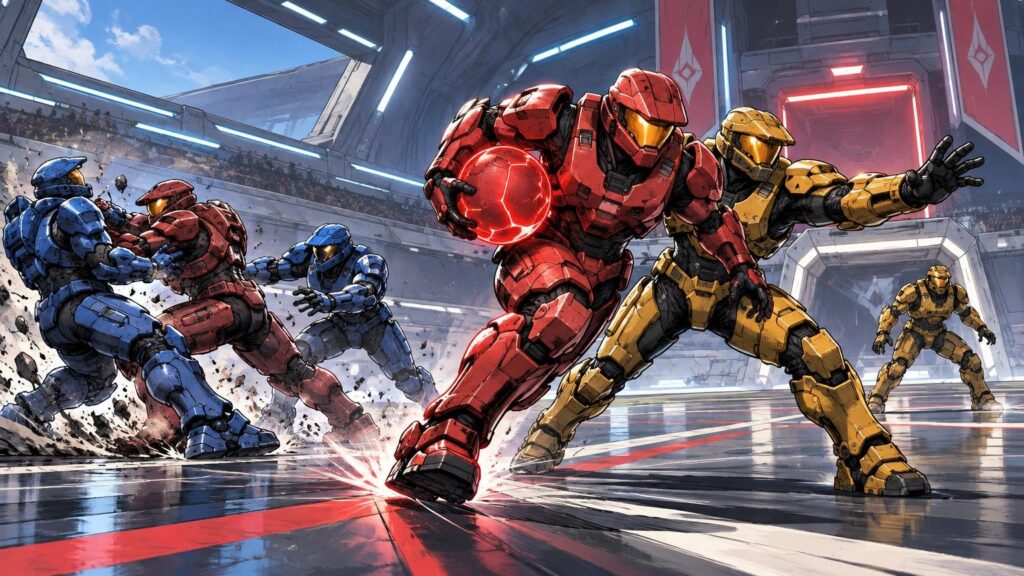
Grifball positions explained simply: the player carrying the ball is the Runner, while Halo Infinite’s current Grifball materials call the three non-carriers tanks. Those labels describe the immediate split, but strong teams divide the tank work into three flexible jobs: escort the Runner, pressure the enemy formation, and remain goal-side as a safety. These are not locked classes. A pass, death, launch, loose ball, or turnover can change everyone’s assignment in seconds.
Grifball is a 4v4 objective mode built around controlling the ball, protecting your Runner, and stopping the opposing push. If you need the basic premise first, start with this introduction to Grifball’s rules and appeal. Halo Infinite added Grifball matchmaking with the Summer Update released on June 10, 2025.
The important distinction is between official current language and useful team shorthand. The official Halo Grifball overview calls the carrier the Runner and the other players tanks. It does not establish escort, point fighter, safety, blocker, or hybrid as mandatory positions. Those labels are best treated as coaching language for responsibilities that rotate throughout a round.
Grifball positions explained at a glance
| Role or job | Primary responsibility | When it changes |
|---|---|---|
| Runner | Carry or pass the ball and choose the safest scoring lane | After a pass, drop, death, or score |
| Escort | Clear the next threat close to the Runner and enable passes or launches | When the Runner changes lanes or another teammate becomes closer support |
| Point fighter | Disrupt the enemy front line and create an advantage before joining the push | After the opening clash, a kill, or a broken formation |
| Safety | Stay goal-side enough to stop a breakaway and recover loose balls | When possession becomes secure or the opponent begins a counterattack |
Only Runner and tank come directly from the supplied current Halo terminology. Escort, point fighter, and safety are practical ways to divide the tanks’ work. Think of them as assignments on a play, not names permanently attached to players.
Runner: the ball carrier and decision-maker
The Runner carries the ball toward the opposing scoring area. In Halo Infinite’s 2025 implementation, the Runner can also pass, turning ball movement into a team weapon rather than a solo charge. The Runner receives an Overshield and has altered movement: stronger forward movement, reduced backward movement, and no sprint.
That movement profile rewards commitment. Backpedaling away from every hammer threat wastes the Runner’s best direction of travel and can compress the team into its own half. A better Runner identifies the most promising lane, moves decisively, and tells the tanks where the push is going.
The Runner’s core decisions are straightforward but demanding:
- Choose the lane with the clearest path, not necessarily the shortest path.
- Stay close enough to an escort that a tank can remove the next obstacle.
- Pass when a teammate has a better angle or when holding the ball would end the attack.
- Avoid outrunning support merely because the forward movement feels fast.
- After passing, immediately become support for the new Runner instead of watching the play.
The final point is crucial. Passing does not remove a player from the action; it rotates the roles. The former Runner may become an escort, a screen between the carrier and an enemy tank, or the safety if the pass sends teammates forward.
Tank: the broad role for every non-carrier
Halo’s current explanation uses tanks for the three players who are not carrying the ball. Tanks have the Gravity Hammer and Energy Sword, can sprint, and can use techniques including hammer jumps and teammate launches. Halo also presents passing, launching, hammer jumping, and ball deflection as intentional parts of the mode’s play.
A tank is therefore not just a player swinging at the nearest Spartan. Tanks manufacture space. Sometimes that means winning a duel. It can also mean threatening a lane, launching a teammate, deflecting the ball, delaying an enemy Runner, or simply surviving in the correct place.
Escort or blocker
The escort stays near enough to solve the Runner’s next problem. That may mean removing a defender, occupying an enemy so the Runner can slip past, receiving a pass, or setting up a launch. “Blocker” is recognizable community language, but escort describes the modern job more clearly without implying an official class.
Good escort spacing is close, not crowded. Standing directly on the Runner can let one hammer swing disrupt both players. Hanging too far away leaves the carrier isolated. The useful distance is the one from which the escort can engage the next threat without obstructing the Runner’s movement or pass.
Point fighter or pressure player
The point fighter contests the first collision and disrupts enemy support. This player often begins ahead of the Runner, but the goal is not to chase kills indefinitely. The goal is to create a temporary numbers advantage or force the defense out of shape, then reconnect with the attack.
A pressure player who wins a duel and immediately helps the push has created value. One who follows a respawning opponent away from the ball may leave the Runner facing two defenders. Pressure is useful when it changes the objective fight.
Safety or defender
The safety remains goal-side when the situation could turn into a breakaway. This is not an invitation to camp at the scoring area for the entire round. The player should be close enough to contribute while preserving an angle to challenge a loose ball or enemy Runner moving toward the goal.
Who stays back should depend on position, not ego. Usually it is the tank already farthest goal-side or the player who can retreat without collapsing the current push. Once possession is secure and the threat has passed, the safety can advance into an escort or pressure assignment.
How Grifball roles rotate during a play
The fastest way to improve role discipline is to call the next responsibility whenever the ball state changes. Do not wait for the team to return to a neat formation; Grifball rarely grants that luxury.
- At the opening clash, one tank pressures the central fight, one prepares to support the first carrier, and one protects against an immediate breakaway.
- When your team gains the ball, the nearest useful player becomes the Runner. The closest tank escorts, the forward player clears space, and the goal-side player becomes safety.
- After a pass, the receiver becomes the new Runner. The passer fills whichever support job is now empty.
- After a teammate launch, the team must account for the space left behind. A dramatic launch is worthless if every tank follows it and exposes the goal.
- When the ball becomes loose, roles temporarily collapse around recovery. One player secures it while teammates establish a forward outlet and defensive cover.
- After a turnover, the closest tank delays the opposing Runner. Another attacks the escort, while the deepest player protects the scoring lane.
- After deaths or respawns, players take the jobs their positions allow instead of trying to reclaim their preferred roles.
This constant rotation is why basic survival and timing matter more than collecting flashy eliminations. For more fundamentals on spacing, timing, and avoiding the hammer blender, see how to play Halo Infinite Grifball without getting flattened.
A flexible four-player starting shape
Beginners can use a simple four-part shape: Runner, nearby escort, forward pressure player, and safety. This is a teaching framework, not an official formation or a claim that every attack should look identical.
| Player | Starting assignment | Key question |
|---|---|---|
| 1 | Runner | Where is the safest scoring lane? |
| 2 | Escort | What is the Runner’s next obstacle? |
| 3 | Forward pressure | Which enemy support player can I disrupt? |
| 4 | Safety | Can we stop an immediate turnover and breakaway? |
The shape gives every player a question to answer. It also prevents two common beginner failures: all three tanks bunching around the carrier, or all three charging forward while nobody covers a turnover. As players improve, the formation can stretch, rotate, or disappear entirely without losing those underlying responsibilities.
Classic and Octane change the positioning problem
Halo Infinite’s 2025 Grifball materials describe Classic and Octane variants, with first-person and third-person options for each. Octane adds thrusters. That equipment changes how quickly players can correct their spacing, attack a lane, or recover after committing to a fight.
In Classic, poor positioning is generally harder to repair, so the safety should be especially careful about drifting too far forward. In Octane, thrusters create sharper bursts, escapes, and recovery options, but they also make apparently safe gaps close quickly. Teams should expect faster lane switches and avoid treating a small lead as guaranteed protection.
Perspective can affect awareness and comfort as well, but the same decision framework survives: identify the Runner, clear the immediate lane, pressure useful targets, and preserve defensive coverage. Players comparing how different Halo releases and systems shape the mode can also explore the best Halo games for Grifball fans.
Legacy Grifball terms: defender, blocker, trick runner, and hybrid
Older Grifball communities used a wider vocabulary. An archived 2008 community post reproducing material attributed to the former Grifball.com described defenders, tanks or blockers, trick runners, and hybrids. These labels document how players discussed specialization at the time; they are not a current official Halo Infinite position glossary.
- Defender: a player emphasizing goal-side coverage and stopping enemy pushes.
- Tank or blocker: a combat-focused player clearing space and engaging opposing support.
- Trick runner: a carrier associated with advanced movement, evasive play, or creative scoring approaches.
- Hybrid: a flexible player able to switch between running, combat, and defensive work.
The concepts remain understandable, but modern teams do not need to assign these as permanent identities. “Hybrid” is especially close to how effective Grifball already works: everyone should be prepared to carry, clear, cover, and rotate.
Short callouts that keep roles clear
Useful communication describes the immediate job in as few words as possible. These examples are practical shorthand, not standardized league vocabulary:
- “Escort left” means the Runner is choosing the left lane and needs close support there.
- “Safety back” confirms that one player is protecting against the counterattack.
- “Runner passed” warns everyone that the possession role has changed.
- “Launch ready” tells the Runner or another tank that a mobility play is available.
- “Ball loose” shifts priority from chasing eliminations to recovery.
- “Reset” tells the team to stop overextending and rebuild its spacing.
- “Two on Runner” identifies immediate pressure on the carrier and calls nearby support inward.
Names matter less than consistency. A team using “anchor” instead of “safety” is fine if all four players understand it. The best callout is the one that produces the correct movement before another hammer lands.
Common questions about Grifball positions
Is Runner the only true Grifball position?
Runner is the distinct possession role: it belongs to whoever carries the ball. Current Halo Infinite materials also call the non-carriers tanks, but they do not provide a comprehensive official glossary dividing those tanks into fixed positions. Escort, pressure, and safety are useful functional assignments.
What does a tank do?
A tank creates space or denies it. Depending on the play, that can involve escorting the Runner, fighting enemy support, protecting the goal-side lane, enabling a launch, receiving a pass, or stopping a counterattack.
What is the difference between a tank and a blocker?
Tank is the broad term used for non-carriers in Halo Infinite’s current Grifball explanation. Blocker is an older or informal label for a player focused on removing threats and opening the Runner’s lane. A blocker is performing one tank job rather than occupying a separate required class.
Can the Runner pass the ball?
Yes. Passing is part of Halo Infinite’s 2025 Grifball implementation. Once a teammate receives the ball, that player becomes the Runner and the passer should rotate into an available support responsibility.
Who should stay back on defense?
Usually the player already positioned farthest goal-side or the one who can retreat without abandoning an immediate fight. The safety should still remain close enough to influence play; permanently hiding near the goal gives the opposing team a numbers advantage elsewhere.
Build responsibilities, not rigid classes
The cleanest way to understand Grifball positions is to start with the current Runner-and-tanks split, then divide the tank work into escort, pressure, and safety duties. That gives beginners structure without pretending the game has four locked classes.
On your next round, make one change: call out who has safety every time possession changes. Once that habit holds, add the escort call and then the forward-pressure assignment. A team that knows who is carrying, clearing, and covering will look organized even when the arena is one glorious storm of hammers.